Some of the Guanche dead are still whole enough that you can see skin, and in a few cases hair. They are people who lived on Tenerife before the Castilian conquest. The preservation is real. What happened after the caves were opened is the part that still has not finished.
Not every body was prepared the same way
The usual resting place was a cave, often near where people lived, and often awkward to reach. Some bodies simply dried because the cave was dry and steady. Others were prepared on purpose. The name for that work is mirlado. Chronicles put it at about a fortnight. The body was washed. Animal fat and plant or mineral substances could be rubbed on. Drying did the main work: sun, air, and, as museum researchers describe it, possibly smoke and heat from fires. At the end the body was wrapped in skins, usually goat or sheep, sometimes sewn into a bundle. Old accounts say the number or quality of skins could mark rank. That part is still argued.
Early European writers also said the embalmers took out the organs, and sometimes the brain, the way Egyptian practice was understood in Europe. Scans of the bodies that survive have not shown that as a routine step. In some of them the organs are still there. The preservation came from drying and wrapping, not from emptying the torso.
The caves were emptied
After the conquest, a preserved body was a curiosity. Collectors wanted one. A mummy could be a gift. Another went into a private cabinet. Almost nobody wrote down which cave it had come from. MUNA, the museum in Santa Cruz, describes a long removal. Bodies reached the Iberian peninsula, France, Germany, Britain, Russia, Canada, the United States and Argentina, and the museum knows of others it cannot now place. In 2022 it opened a room on that exodus. Of the dispersed bodies it could document, five had been brought back.
The man from Barranco de Erques
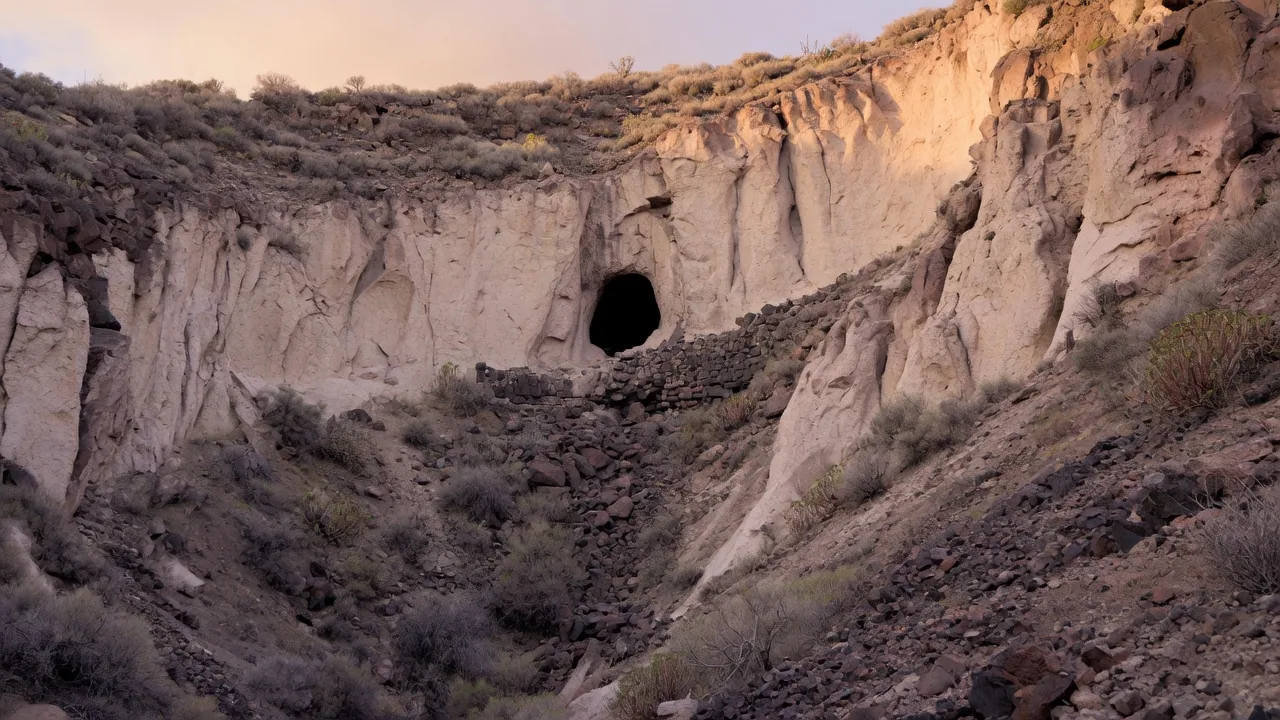
The cave everyone still names is in Barranco de Herques, also called Erques, between Güímar and Fasnia. Eighteenth-century reports speak of a great many preserved bodies there. One telling grew into a cave of a thousand mummies. That number is a story. The cave was cleared, so a modern count of it does not exist.
One man from that cave was chosen because he was unusually complete. He was given to King Charles III, and by 1776 he was in the Real Gabinete de Historia Natural in Madrid. He is an adult, about 1.62 metres tall, who died between roughly 35 and 40. A study dates him between 1154 and 1260. Hair and teeth remain. He was not eviscerated. From 2015 he was on show at the Museo Arqueológico Nacional. In February 2025 Spain's state museums took human remains off public display, and he was moved into storage there. The Cabildo of Tenerife has asked for him, repeatedly, since 1976. MUNA shows a replica. The man is still in Madrid.
Five came back
Two bodies from a private collection linked to Tacoronte were sold in the nineteenth century and ended up in the natural-history museum at Necochea, in Argentina. They came home on 2 September 2003: a woman of about 20 to 24, and a man of about 25 to 29. It was the first return of Guanche bodies from overseas.
Three more had passed through Spanish collections and reached the forensic museum at the Universidad Complutense in Madrid. An agreement signed on 4 November 2009 brought them back in February 2011. The museum record describes a woman of 25 to 29 who had lost her upper teeth in life, a man of 30 to 34 who still has traces of beard and a little of the membrane around the heart, and another woman of 25 to 29 whose torso still holds organs. That third preservation looks natural, not prepared. They are incomplete. They are also specific people, not a type.
A child from Barranco del Infierno
MUNA also holds a child from Barranco del Infierno, in Adeje, dated between 1264 and 1401. The museum record gives an age of seven or eight, and sex as possibly male. The body was wrapped in goat skins, hair side inward in places, head covered, legs wrapped apart. The skeleton is complete. Part of the eyes and the nose remain. There is no sign that the organs or the brain were taken out, and no sign in the bones of malnutrition. How the body was found is not known. It was given to the scientific cabinet in Santa Cruz around the end of the nineteenth century or the start of the twentieth, and entered the archaeological museum in 1958.
What the bodies are used for now
Bone already carries age, sex, height, injury and teeth. Soft tissue carries more. Since 2019 the museum has run CT scans on selected bodies and mummified skulls, including the three from Madrid, and the work is still being written up. The point of a scanner is to look without cutting. The same machines also show what later museums did to a body: supports, fills, old repairs. A person who died several centuries ago can be examined in a hospital scanner. That does not turn them into an object. It is why the argument about display is not only a scientific one.
MUNA has complete bodies and a larger number of fragments. It does not have a total for everyone who was ever laid in a cave. Looting threw the context away. Some bodies went into collections that were never listed. Some caves may not have been found. Five documented returns, against a dispersal that ran for centuries, is a small repair.
If you go
The place to see this properly is MUNA in Santa Cruz, in the Guanche funerary rooms. You will be in front of real bodies, including the child from Adeje, and in front of the replica of the man who is still in Madrid. It is not an Egyptian-tomb show. These people lived in the ravines and looked at the same mountain. The caves were meant to keep them. The collecting scattered them. Bringing even five home is the unfinished part of the story.
FAQ
Did the Guanches make mummies?
Some bodies dried in the cave. Others were prepared, a process called mirlado: washed, treated, dried over about a fortnight, and wrapped in goat or sheep skins. Scans have not shown routine removal of the organs or the brain.
Where is the best-preserved Guanche mummy?
The man from Barranco de Erques is in the Museo Arqueológico Nacional in Madrid. He came off public display in February 2025 and is in storage. Tenerife has asked for his return since 1976. MUNA exhibits a replica.
How many have come back to Tenerife?
Five that the museum can document: two from Necochea, Argentina, on 2 September 2003, and three from the Universidad Complutense in Madrid in February 2011.
Is there a child?
Yes. A child of about seven or eight, from Barranco del Infierno in Adeje, dated between 1264 and 1401, is in the MUNA collection. The record lists the sex as possibly male.
Where can I see them?
At MUNA, the Museo de Naturaleza y Arqueología, in Santa Cruz de Tenerife. The galleries include preserved human bodies. Go knowing that.
Fact-Checking Sources
Share this article