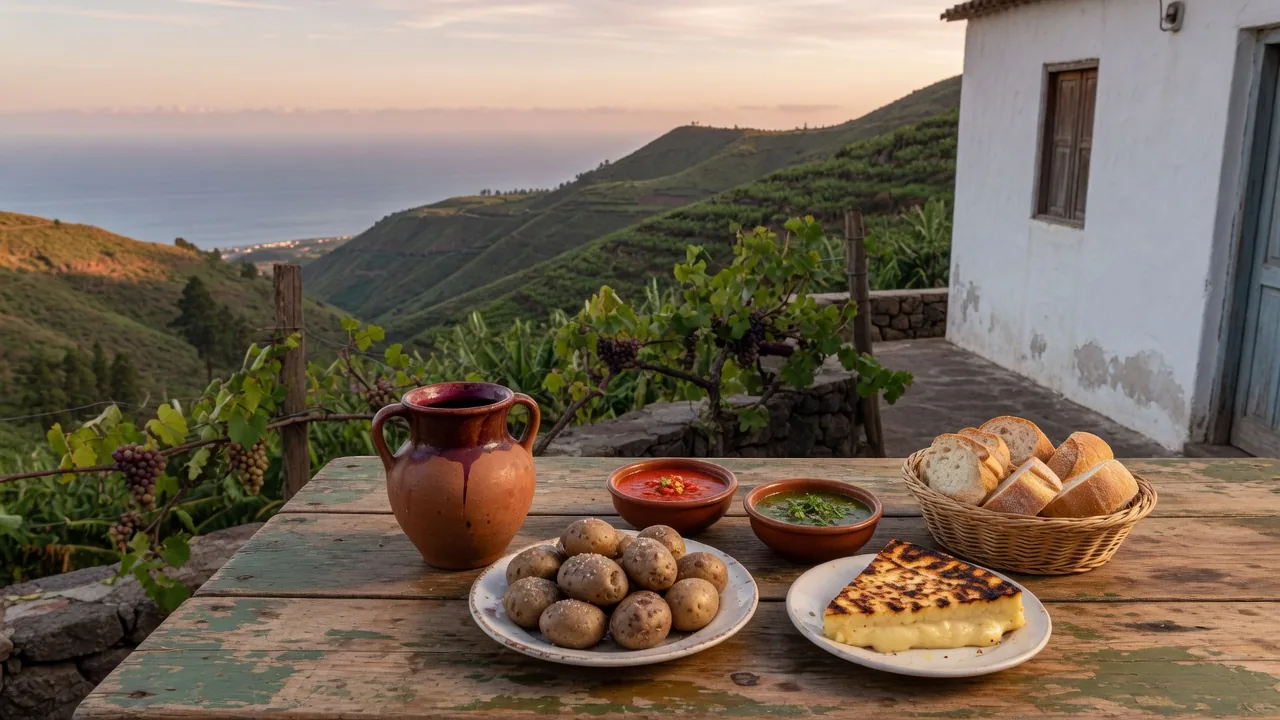
If you want a meal that belongs to Tenerife, go inland from the north coast and look for a guachinche. Not a seafront dining room with a menu in six languages. A family place beside a vineyard, or in a plain farm building, with a jug of their own wine and a short list of dishes from the kitchen.
It started as a way to sell the harvest
A guachinche is not just a rustic restaurant that kept the old furniture. The traditional one is tied to a winegrower. The point of opening the door was to sell wine from that year's own grapes. The food came with it, because people do not sit long over a jug with nothing on the plate.
The word travelled further than the practice. Plenty of ordinary restaurants now put guachinche on the sign. In 2013 the Canary Islands government drew a line. Decree 83/2013 covers the temporary sale of wine from the holder's own harvest, and the simple kitchens where that sale happens. Places that pour someone else's wine, stay open all year, or run a long menu are restaurants. They follow the normal restaurant rules.
Under that decree the wine has to come from vineyards the holder owns or works, and the holder has to make it. The door can stay open for four months at most, and it closes when that wine is gone. Cooked food is capped at three dishes, plus pickles, nuts and fruit from the holding or the area. Drinks are that wine, and water. Each year the holder tells the island council when the place opens and when it shuts. An official plaque has to be visible by the main door.
Why the north has so many
Wine has been part of Tenerife since soon after the conquest, and by the 1500s it was already leaving the island for Europe. Volcanic ground, height and a stack of small climates gave the north, in particular, a reason to keep planting. Families with a few terraces of vines needed a way to sell the harvest without turning the house into a restaurant. They opened a room, poured their wine, and cooked a small set of dishes to go with it. The meal became the excuse to stay.
Tacoronte-Acentejo is one of the old wine districts. Around it, La Orotava, Santa Úrsula, La Matanza de Acentejo, Tacoronte, La Victoria de Acentejo and El Sauzal are the usual ground. The hills explain the habit: vines, old houses, green terraces and narrow roads between the villages. Tenerife's tourism pages put the same cluster in the north, and they describe the guachinche as a family kitchen for the grower's own wine.
What arrives on the table
The board is short on purpose. What you get depends on the house and the day. These are the plates people mean when they talk about a guachinche.
Papas arrugadas are small potatoes boiled in very salty water until the skins wrinkle, then served with mojo. Red mojo is the pepper one. Green mojo is the coriander one.
Queso asado is local cheese, often goat, heated on a griddle until the outside colours, usually with mojo beside it.
Carne fiesta is pork cut small and marinated with garlic, herbs and spices, then fried.
Conejo en salmorejo is rabbit in the Canarian marinade: garlic, cumin, vinegar, paprika, oil and herbs. It is not the cold tomato soup that the Spanish mainland calls salmorejo.
Goat turns up stewed. Costillas con piña are pork ribs with potatoes and piña de millo, which is corn on the cob. In this kitchen piña does not mean pineapple.
Bread is there so the sauce does not stay on the plate. A jug of the house wine does the rest. If there is a pudding, it will be a simple one.
The wine is the whole idea
In a place that actually follows the decree, the wine in the jug is from that holding, not a list of bottles from elsewhere. You may not get a printed list. Someone asks red or white, and the jug comes. That is the old way of doing it.
Why the place you saved is shut
This is the mistake. A friend sends a name, you drive up from the south, and the shutters have been closed for months. For a regulated guachinche that can be exactly how it is supposed to work. The season is the wine. Many houses open once the new wine is ready, often from late November, and stay open into March or April, but the dates are not a law. The law is four months, then stop, and stop earlier if the wine runs out. The reliable check is the notice on the door, or a phone call, before you cross the island.
How to tell the regulated ones apart
Look for the plaque by the door, a board with a few dishes, and wine from that house. A full restaurant menu, cocktails and a shelf of imported bottles means you are in a restaurant that likes the word guachinche. The food there can still be good. It is a different afternoon. The decree exists so the two are not sold as the same thing.
A few names from a local shortlist
Once the difference is clear, the useful next step is a slow loop through the north. Names that come up among local tables include Guachinche Casa Mi Suegra, Guachinche Romance, Mesón El Monasterio, Bar Teno Alto La Venta, Bodegón Vargas, Bar Juan Luis, Restaurante Mundial 82, Terraza La Piñata, Restaurante Historias Para No Dormir, Restaurante La Cueva and Bar Tasca Tonazaro.
Do not file every one of those as a regulated guachinche. Some are ordinary Canarian bars, bodegones and restaurants on the same kind of road: local food, a plain room, lunch that runs long. The regulated version is still the owner's wine, a short menu and a door that closes with the harvest.
Treat the names as a pocketful of options, not a list to finish. Pick one municipality, take the slower road, and notice where families are sitting, especially on a Sunday. For the seasonal houses, check the opening days before you make the drive the point of the day. From Costa Adeje or Los Cristianos, the map underestimates the north. Leave the margin.
What the room is like
The chairs may not match. The prices may be on a board. You might be looking at vines, or at the side of a converted store. None of that is a failure of the place. A guachinche is a working kitchen attached to a harvest, and the pleasure is the long table: a few shared plates, the house wine, and no need to schedule the next course.
A day by the pool in the south is still a good day. The north hills are how the island gets larger than the resort strip. You drive through vines and old houses, then someone puts papas arrugadas, mojo and a jug on the table.
FAQ
What is a guachinche?
A seasonal family kitchen in Tenerife, opened so the holder can sell wine from their own harvest, with a few homemade dishes alongside it.
When do guachinches open?
Decree 83/2013 limits a regulated guachinche to four months a year, and it must close when the holder's wine runs out. Many open from late November into March or April. Check the door or call before you go.
What should I order?
Papas arrugadas with mojo, queso asado, carne fiesta, conejo en salmorejo, stewed goat, or pork ribs with corn and potatoes. Share them, and take the house wine.
Is Canarian salmorejo a cold tomato soup?
No. On Tenerife, salmorejo is the marinade used for the rabbit: garlic, cumin, vinegar, paprika, oil and herbs. The tomato soup of that name belongs to mainland Spain.
What does piña mean on a guachinche menu?
On costillas con piña it means piña de millo, corn on the cob, served with the ribs and potatoes. It does not mean pineapple.
How do I know it is a regulated guachinche?
Look for the official plaque, wine from that holding, no more than three cooked dishes, and water rather than a full bar. A long menu and imported bottles mean a restaurant using the name.
Fact-Checking Sources
Share this article