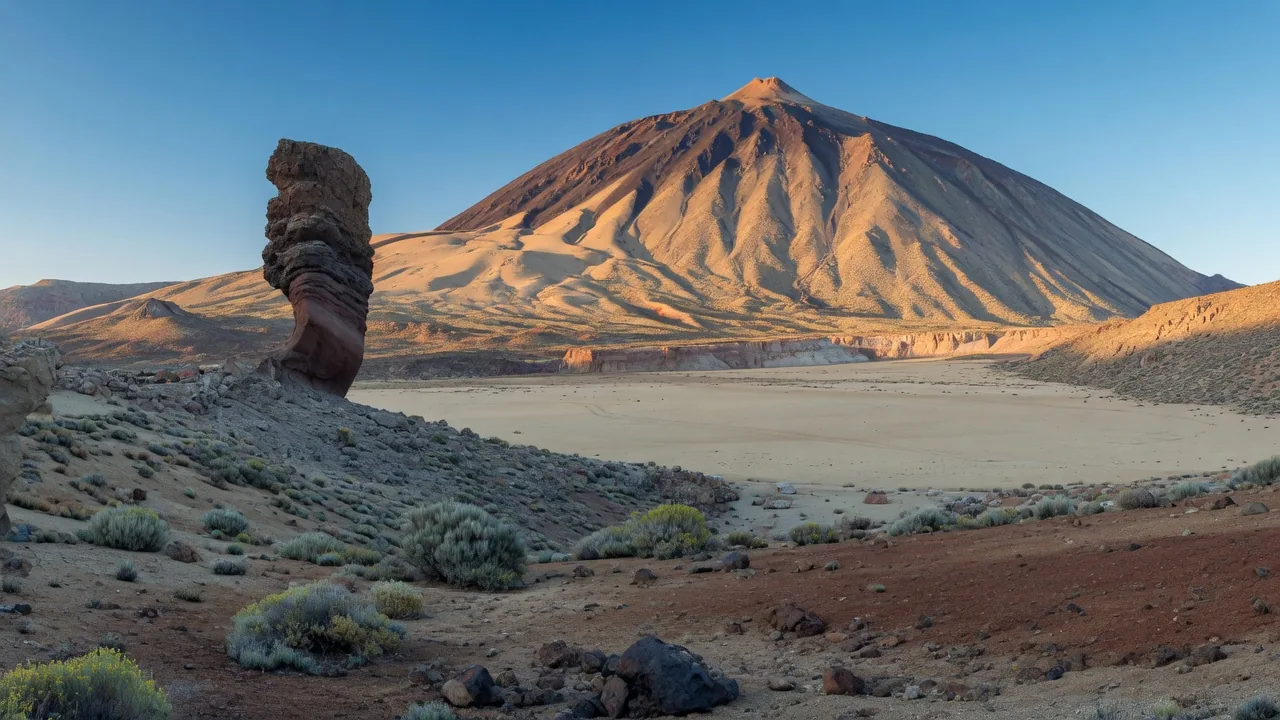
Most people meet Mount Teide as a ticket. The cable car has a queue, the crater has a permit, and those are the photographs on the brochure. The caldera around them is a different visit. TF-21 crosses Teide National Park from El Portillo, in the north-east, to Boca Tauce, in the south-west, and nobody collects a ticket on that road. Snow, fire and roadworks still close it.
From the lay-bys you can see the Roques de García, a plain of pale dust, a band of green rock, the lava of 1798 and hills of pumice. None of that needs the cable car. Two walks on the cone itself are now booked and, for most visitors, paid. Those are separate from the drive.
The road is the free part
There is no entrance fee for driving into the park. The caldera floor sits at about 2,000 to 2,200 metres, and every stop in this piece is up there. The sun is harder than it is on the coast, the wind can arrive in an hour, and a clear morning can close in. Take water, something warm and sun protection. Stay on the marked ground. Since June 2026 the Cabildo has banned smoking in the open, apart from a covered building that expressly allows it. Taking rocks, plants or pumice away is also forbidden. Before a walk, check the alerts on Tenerife ON. Trails still close for weather, fire risk and repair.
The towers at Roques de García
The postcard is at kilometre 46 of TF-21, opposite the Parador. Mirador de la Ruleta is a few steps from the car park. From the railing the ground falls away into Llano de Ucanca, a flat of cream and rust-coloured dust, and the towers called the Roques de García stand between you and the cone. The thinnest is Roque Cinchado. For years it was the picture on the Spanish 1,000-peseta note: the rock in front, Teide behind.
These are not a pile of loose rubble. They are harder stone that cooled in the cracks of an older volcano. The rock around them wore down, and this rib was left standing across the caldera.
Trail PNT-03 leaves from the same mirador and circles the rocks. Tenerife ON measures it at about 3.5 kilometres and just under two hours, with about 200 metres of climbing, almost all of it on the way back up from the plain. The national park calls that return steep. The first stretch, out toward Roque Cinchado, is nearly level, and a short path from the railing runs in among the first rocks with no booking. The full loop needs no permit either. It does need shoes that grip, because the last zigzags are loose. Stay on the loop. It links to trail PNT-23, Los Regatones Negros, and that path does need a permit.
The green rock and the plain
Llano de Ucanca is the flat you see from La Ruleta. It is the floor of this side of the caldera, pale because it is full of pumice and dust washed off the walls. You drive along the edge of it. The stop is the view, not a walk across the middle.
A short way south of the Parador the road passes Los Azulejos, the tiles. The cutting is green, blue-green and rust, in a wall that is otherwise grey and cream. The rock began as a pale phonolite, a fine volcanic stone. Hot water moved through it and changed the minerals. Spain's geological survey describes the red as iron left in the altered clay, and the blue-green as very fine secondary minerals filling cracks in the stone. Copper is not what colours it. The main band sits about 800 metres south of the Parador, with smaller patches continuing toward Boca Tauce. Park in the lay-by, and leave the rock where it is.
A shoe and a black lava field
Still south of the Parador, TF-21 has a lay-by at Zapato de la Reina, the queen's shoe. It is one eroded block. From the right angle the silhouette reads as a heel and a toe. From another angle it is simply a rock. The bay is small. If it is full, the next lay-by is a better idea than the edge of the road.
Boca Tauce is the junction of TF-21 and TF-38, and the south-west door of the park. From here the south side of Teide and the cone of Pico Viejo sit in one view, with a tongue of black lava beneath them. That lava came out of the west flank of Pico Viejo between 9 June and 8 September 1798. The name for the eruption is Narices del Teide. The geological survey calls it the last eruption inside the area of the national park. Two centuries is nothing for a lava field at this height, which is why it still looks new. TF-38 crosses the flows. You can see them from the junction without a ticket.
Walking up to the vents is a different outing. Trails PNT-09 and PNT-28 leave this side of the park toward Pico Viejo and the Narices, and both need a permit on Tenerife ON. The view from the road is the one that does not.
Pumice, then the lava balls
After the Parador, TF-21 bends past the cable-car station and on to the Mirador de Montaña Blanca, at kilometre 40.2. The pale pumice on this side of the caldera is Minas de San José. The name is left over from digging in that pumice. The viewpoint itself is a little further on, at kilometre 38.6, still before El Portillo. You pull into a bay and walk a short way on the marked ground: pale pumice, and almost nothing growing. The cable-car car park is a different place. It is open while the cable car is running, and it is closed at night.
The Montaña Blanca mirador is the start of trail PNT-07. The parking there is small. The path climbs onto the pale flank, and on that flank sit the Huevos del Teide, the eggs of Teide. The national park describes them as large balls of lava that left the vent, rolled down the slope and came to rest. They are black. The ground under them is light, which is why you can pick them out from a distance.
Seeing them is not a summit day. They are on the early part of the path. Tenerife ON says you validate a booking about 4.6 kilometres from this mirador, where the trail meets the branch to the top of Montaña Blanca. Past that checkpoint, PNT-07 is a high-mountain route to La Rambleta, the upper station, with more than 1,300 metres of climbing. If you only came for the eggs, turn round before the checkpoint.
Where the fee starts
The drive, the miradores and trail PNT-03 stay free. Since 19 January 2026 the Cabildo of Tenerife has charged for daytime slots on two trails. You book them on Tenerife ON. Residents of Tenerife still pay nothing, but they still need the booking. The price on the booking page is the one that counts. These are the figures the Cabildo published.
On the summit path, PNT-10 Telesforo Bravo, the charge runs from 09:00 to 17:00. Children under 14 pay nothing. Residents of the other Canary Islands pay 6 euros. Everyone else pays 15 euros.
On PNT-07, from Montaña Blanca to La Rambleta, the charge runs from 09:00 to 15:00. On a weekday, residents of the other islands pay 3 euros and other visitors pay 6. On a weekend or a public holiday those prices are 5 euros and 10 euros.
The permit is in a person's name. Take the same identity document you used to book. New dates open every Monday at 07:00, Canary time, and you can book up to 56 days ahead. A cable-car ticket does not include either trail. The cable car is run by a separate company, Teleférico del Pico del Teide, and the upper station is at about 3,555 metres. The crater is the short path above that, and the summit is 3,715 metres. That last path is its own permit.
El Portillo, when the plants are out
The north-east gate is El Portillo, at kilometre 32.1 of TF-21. Beside the visitor centre is a botanical garden of about 4 hectares. Tenerife ON says the paths hold more than three quarters of the park's higher plants, on ground that is mostly gentle, including an accessible loop. There is no separate ticket, and no permit, for walking it. It is the easiest place to learn the plants without leaving the road.
The plant people cross the island for, in late spring, is the tajinaste rojo, Echium wildpretii. A red spike comes up out of a grey-green rosette, often from May into June, and it can stand taller than a person. That plant flowers once, and then it is finished. A good year in the garden is not a promise about the wild slopes, or the other way round. Check that the centre is open before you drive across for it. Hours change.
If you go
From the south, take TF-21 up through Vilaflor. You meet Boca Tauce, the queen's shoe, Los Azulejos, then La Ruleta and the Roques. After the Parador the road passes the cable car, the Montaña Blanca mirador and the pumice of Minas de San José, and it leaves the caldera at El Portillo. From there you can drop down to La Orotava, or turn back. From the west, TF-38 joins at Boca Tauce. From La Laguna, TF-24 reaches El Portillo and you drive the same road the other way.
Go early. The bays at La Ruleta and the cable car fill first. TITSA lines 342, from the south, and 348, from the north, stop at El Portillo, Montaña Blanca and the Parador. They do not set you down at every lay-by, so the full string of stops is a car, or a day with a guide.
If you would rather not drive TF-21, a guided day is the simpler way around the same caldera. Banana Ventura lists Teide excursions with hotel pickup. Ask whether the tour stops at the Roques, or only at the cable car. The cable car, and the path from the upper station to the crater, are booked apart from the drive.
FAQ
Is the national park free?
Driving in, and the roadside stops in this guide, are free. The cable car is a paid ticket. Since 19 January 2026, daytime slots on trails PNT-07 and PNT-10 are charged for anyone who does not live on Tenerife.
Do I need a permit for the Roques?
No. Trail PNT-03, and the short path from Mirador de la Ruleta, are open without a booking. Trail PNT-23, which links off the loop, is not.
Why is Los Azulejos green?
Hot water altered a pale phonolite. The geological survey puts the red down to iron in the altered clay, and the blue-green down to fine secondary minerals in the cracks. Copper is not the cause.
Can I see the lava balls without paying?
The Huevos del Teide are on the early part of trail PNT-07, before the checkpoint about 4.6 kilometres from the Montaña Blanca mirador. Continuing to La Rambleta needs a Tenerife ON booking, and a daytime fee if you do not live on Tenerife.
Where do I book the summit?
On Tenerife ON, for trail PNT-10. The cable car is a separate ticket, from the cable-car company, and it does not include the path to the crater.
Fact-Checking Sources
- Cabildo of Tenerife, 19 January 2026, on the daytime fees for trails PNT-07 and PNT-10
- Tenerife ON, on permits, the Montaña Blanca checkpoint and the cable car as a separate ticket
- Tenerife ON, trail PNT-03, on the Roques de García loop from Mirador de la Ruleta
- Teide National Park, on trail PNT-07 and the lava balls called Huevos del Teide
- Geological Survey of Spain, on the colour of Los Azulejos
- Geological Survey of Spain, on the 1798 eruption called Narices del Teide
- Tenerife ON, on the botanical garden trail beside the El Portillo visitor centre
Share this article