Adeje, Anaga, Güímar, Tacoronte, Tegueste, Icod. Visitors say these names every day, usually as a turn on the road. They are older than the towns built on them. They belong to the Guanches, the people who lived on Tenerife before the Castilian conquest.
The name belongs to this island
People often use Guanche for every pre-Hispanic inhabitant of the Canary Islands. That is the loose way of talking. The name belongs to the indigenous people of Tenerife. Gran Canaria, La Palma, La Gomera, El Hierro, Lanzarote and Fuerteventura had their own communities and their own names. A person from one of those islands before the conquest was not a Guanche.
Where the first settlers came from
A 2023 genome study in Nature Communications, led from the University of La Laguna, places the lasting settlement of the archipelago around the third century of the Common Era. Radiocarbon dates for the first population fall between the second and fifth centuries. The ancestry of those people fits North Africa, close to ancient Amazigh, or Berber-related, populations, with other older components already present in the Maghreb.
That leaves the hard practical question. The African coast is a few hundred kilometres of open Atlantic away. Someone crossed it with people, goats, sheep, pigs, dogs and seed. After that, contact looks very thin. The same study finds little gene flow between the islands themselves. Over the centuries each island became its own small world. When Castilian ships arrived in the late Middle Ages, they met societies that had been living apart for a long time.
A toolkit made from the volcano
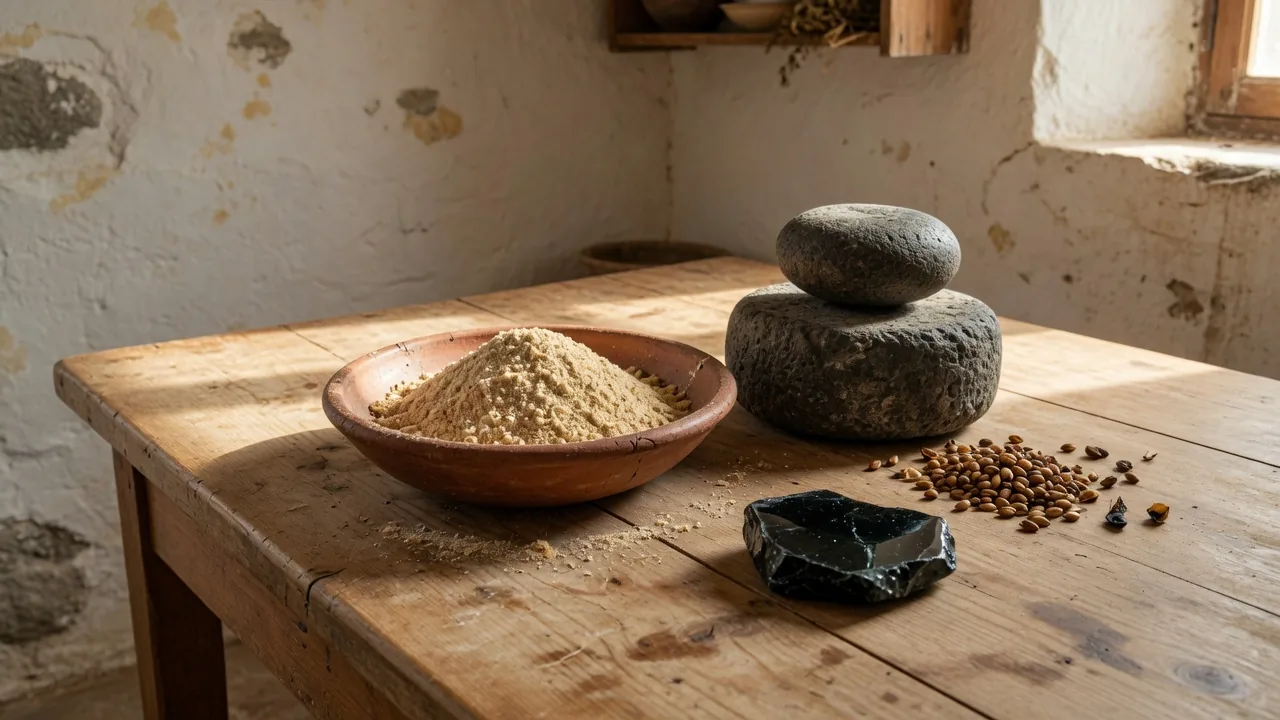
Pre-Hispanic Tenerife had no metal industry. The tools were the rock. Basalt could be shaped into implements. Bone became points and needles. Obsidian, the volcanic glass of the high mountain, breaks into an edge sharp enough to cut. The small blades made from it are called tabonas. A visitor now looks at that black glass and sees a souvenir stone. For the people who lived here it was a knife, and the mountain was where you went to get it.
Goats, grain and gofio
If one animal explains daily life, it is the goat. Herds of goats and sheep, and pigs, gave meat, milk, skins and bone, and they decided how people moved between coast, ravine and high ground through the year. Barley and other grains were grown, then roasted and ground on stone. That meal is still on the island. Gofio is in every supermarket, next to the milk, because Canarian cooking never dropped it. It was already everyday food before Castilian rule.
Caves were a sensible house
On this island a cave is shelter that the rock has already built: cooler in the sun, out of the wind, and free of the need to cut timber for every wall. Some caves were houses, some were stores, some were for burial, and people also built simple shelters. Settlements followed the ravines, the water and the grazing, instead of laying a town plan over them.
Nine territories, and the names are still on the signs
By the time the conquest started, Tenerife was split into nine territories, the menceyatos. Each had a leader, a mencey. Their names were Abona, Adeje, Anaga, Daute, Güímar, Icod, Tacoronte, Taoro and Tegueste. They were not an office grid. They followed grazing, water and the routes between them. Anyone who has driven the island knows why twenty kilometres can change the whole economy of a day: dry coast, green north, a barranco, then the high mountain. For people living off that ground, the boundary was the landscape.
They did not all meet the Castilians the same way. Some menceyatos made agreements. Others fought. The strongest resistance was in the north, under Bencomo, mencey of Taoro.
What we cannot honestly reconstruct
There is no Guanche library. What we have on belief is archaeology plus accounts written by Europeans during and after the conquest, often reading an unfamiliar religion through a Christian frame. A careful reading allows a spiritual life tied to natural forces, the dead, and beings the chroniclers tried to name. It does not allow a tidy mythology. Teide sat over every one of those territories. You can stand above the cloud at sunrise and see why a mountain like that would carry meaning. That is not the same as knowing the story they told about it.
The dead
Many of the dead were laid in caves, often together. Some bodies were preserved by a process called mirlado: washed, treated with animal fats and plant or mineral substances, dried, and wrapped in skins. The result is a mummy, and it is a Canarian practice, not an Egyptian one copied in the Atlantic. Later writers sometimes said the embalmers removed the organs and the brain. Studies of the bodies have not supported that.
Some of those people are at MUNA, the Museo de Naturaleza y Arqueología in Santa Cruz. The point of going is the context the museum builds around daily life and burial, not a glance at a body. Once you have seen that a named practice and a set of tools belonged to individual lives, the place names on the ring road stop sounding like labels.
1494 to 1496
Tenerife was among the last of the islands to be taken. Alonso Fernández de Lugo landed in 1494. In May of that year his force was ambushed in the barranco of Acentejo and badly beaten. The town there is still called La Matanza de Acentejo, the slaughter. He left, raised another army, and came back. In November 1495 the Castilians won on the plain of Aguere, where La Laguna stands now. Most accounts say Bencomo was killed in that battle. His son Bentor took over Taoro. In December the Castilians won again near the place now called La Victoria de Acentejo. By the summer of 1496 the remaining leaders had surrendered, and the island passed to the Crown of Castile.
The dates are the easy part. War, disease, enslavement, displacement and conversion broke Guanche society as an independent political world. The people were not erased on a single afternoon. Survivors were baptised, married into the new colony, and over generations mixed with settlers from Europe and with people brought to the islands by force. The 2023 study models present-day Canarians as mostly Spanish in ancestry, with about 18 percent from the indigenous population and a smaller sub-Saharan share. That 18 percent is an average from one model. It is not a personal quota, and it is not the same on every island.
Where to start on the island
MUNA in Santa Cruz is the straightforward place to see the archaeology properly: tools, food, burial, and the limits of what the evidence can say. After that the useful sites are not a fenced ruin. They are the signs. Drive toward Adeje or Güímar, or up through Acentejo toward La Matanza and La Victoria, knowing those names were territories before they were municipalities. A cave in a barranco was sometimes a house and sometimes a grave. A packet of gofio is the part of this history you can eat.
Teide is still the mountain in the middle of that map. The cable car, the road and the observatory are new. Every one of those nine territories had the same peak in view.
FAQ
Were all ancient Canarians Guanches?
No. Guanche refers to the indigenous people of Tenerife. The other islands had their own peoples.
Where did the Guanches come from?
Genetic work ties the first permanent settlers of the Canary Islands to North Africa, with a strong Amazigh, or Berber-related, component. A 2023 study puts the settlement around the third century of the Common Era, within a wider window from the second to the fifth century.
Did they have metal?
No metal industry. They worked basalt, bone and obsidian. The small obsidian blades are called tabonas.
Did they live only in caves?
Caves were houses, stores and graves, and people also used built shelters. The cave was a practical use of volcanic rock, not the whole of the society.
What were the nine menceyatos?
Abona, Adeje, Anaga, Daute, Güímar, Icod, Tacoronte, Taoro and Tegueste. Each was led by a mencey.
When was Tenerife conquered?
The fighting ran from 1494 to 1496. The defeat at Acentejo was in May 1494. The Castilian victory at Aguere was in November 1495. The remaining leaders surrendered in the summer of 1496.
Where can I see this on Tenerife?
Start at MUNA in Santa Cruz, then read the old names on the road: Adeje, Anaga, Güímar, Tacoronte, Tegueste, Icod, La Matanza and La Victoria.
Fact-Checking Sources
Share this article