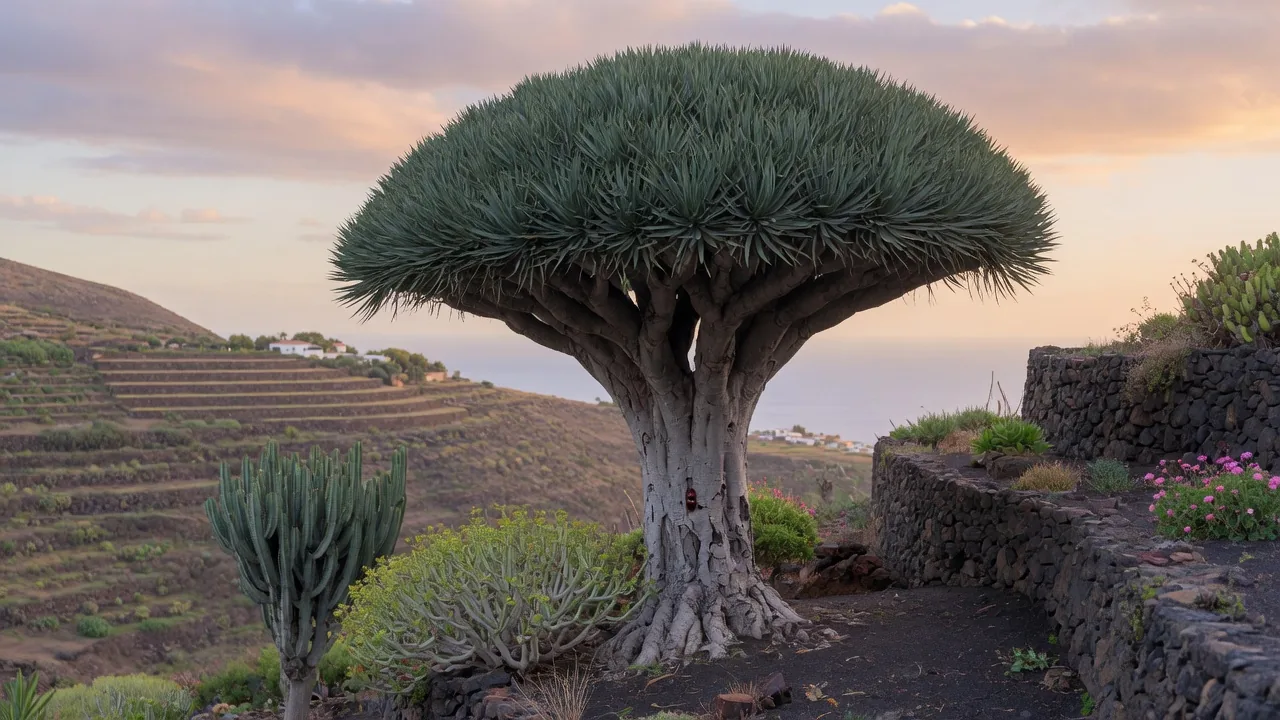
Drive the island for a day and the same tree keeps turning up. A thick grey trunk, then a crown that splits and splits until it looks like an umbrella made of swords. It stands in roundabouts, in hotel gardens, and over the old centre of Icod de los Vinos. The local name is drago. The species is Dracaena draco.
There is no dragon in Teide. The dragon in the name is the sap.
Not a normal tree
A drago looks like a tree and lives like one, but it belongs to the asparagus family. The trunk is fibrous. It does not lay down a ring for each year, so nobody can date it by counting. A young plant is a single stem with a head of long leaves, sometimes for many years. After it flowers, that tip divides and new branches take its place. Later flowerings divide those branches again. An old crown is a pile of those splits. The years between flowerings change with the plant and the weather, so the crown will not tell you the age.
The flowers are small, pale cream or yellow, with six petals, packed into sprays that stand out from the leaves. The Icod council says its own tree can carry up to about 1,500 sprays in a good year. The fruit is a small orange berry. Birds eat it and carry the seed.
The sap that turns red
Cut the bark and the sap runs pale. In the air it turns a deep red. The old name is sangre de drago, dragon's blood.
The name is older than the Canarian tourist trade. Red resin from dragon trees was sold around the Mediterranean as a pigment, a varnish and a medicine. The resin in those ancient cargoes usually came from the dragon tree of Socotra, Dracaena cinnabari, not from Tenerife. The Canarian plant makes the same kind of red resin. On the islands it was used as a dye, a varnish and a household remedy, including for gums and toothache. The leaves were cut for fodder and for cord.
The plant is protected, and the wild ones are scarce. Taking a branch for the colour is not a souvenir.
The story of the hundred heads
The council at Icod still prints the story. West of the Strait of Gibraltar lay the Garden of the Hesperides, and some writers placed it in the Canaries. A dragon guarded a tree of golden apples. Hercules, or Atlas, killed it. A tree grew from every drop of blood, and the forked crown stood in for the dragon's many heads. Stand under a mature drago and you can see why the story lasted. It is still a story.
The same page wraps another legend around this particular tree. Four menceyes, Belicar of Icod, Romen of Daute, Pelinor of Adeje and Adjoria of Abona, are said to have met under it to make peace with the king of Spain and spare what was left of their people. That is a story the town tells. It is not a record of the conquest. A meeting under this crown was not written down.
What can be said more safely is that the plant was already growing in the ravines while the Guanches lived on Tenerife, and that the resin was worth having. A great deal of what is written about Guanche religion was composed long after 1496. The drago has collected more romance than most plants. Calling it a sacred tree is a later story. The sources do not show a ritual.
The tree in Icod
The tree people mean is the Drago Milenario, in the Parque del Drago, beside the church of San Marcos in Icod de los Vinos. Milenario means a thousand years old. That is a name.
The council's figures are about 21 metres high and about 17 metres around the base. It calls this the largest and oldest known specimen of the species. Other published measurements differ by a few metres. The base flares, and not everyone is measuring the same line.
On 6 September 1916 the town bought the plot from Guillermina Fajardo y Carballo for 9,000 pesetas. In 1917 the tree was declared a national monument. A Canarian law of 30 April 1991 then made Dracaena draco the plant symbol of Tenerife.
The age is an argument
With no annual rings, every age is an estimate from size and from how many times the crown has branched. The council says about 1,000 years. In 1975 the botanist Karl Mägdefrau published a lower ceiling. He re-measured dragon trees that had been measured in 1925, and from the growth and the flowering periods he concluded that the ones alive in 1971 were under 250 years old, except the Icod tree, which might reach about 365. That way of counting fits a garden tree in kind conditions better than a thin plant on a cliff, so it is not the last word. It is a published reason not to treat the round thousand as a fact.
The ages of several thousand years belong first to a different tree. In the Franchy garden at La Orotava there was a giant that Humboldt and other writers of his century treated as ancient. On the night of 21 July 1819 a storm took more than half its crown. The last scientist recorded as seeing it alive was the German zoologist Ernst Haeckel, in 1866. A gale brought it down on 7 March 1867. A younger drago stands in that garden now. When someone says the dragon of Tenerife is 3,000 years old, the useful question is which tree they mean.
Keeping this one standing
By the early 1980s the council was worried. The trunk is hollow, with a cavity running up inside it. Parts of the wood were rotten, and the tree was at risk of coming apart. The work that followed cleaned out damaged wood and put a fan in the cavity, so the inside would stay drier and fungus would have less to grow on. Plants holding damp against the base were cleared.
The other problem was the road, which passed a few metres from the trunk. In the early 1990s it was moved. The ground around the tree, on the slope of the Barranco de Caforiño, became the park: cardón, tabaiba and the Canary palm, and a short walk through the vegetation bands of the island. The fence, the fan and the diverted road are there so that it stays alive.
Most of the ones you see were planted
A week of driving can make the island look full of dragon trees. Most of those were planted. The wild population on Tenerife is on the old rock, where the cliffs were not ploughed: the north side of Anaga, the cliffs of Teno around Masca, and the walls of Barranco del Infierno in Adeje. The groups are small and scattered.
On Gran Canaria the common drago is treated as extinct in the wild. The last wild individual died in 2009. A different species, Dracaena tamaranae, still grows in the south-west of that island, and only a small number of wild plants are left. On the other Canary islands the trees are planted, or have seeded from planted ones. The species also grows in Madeira and Cape Verde, and a related wild population stands in the mountains of south-west Morocco. A drago in a Tenerife roundabout is not a report on the wild plant.
Spain lists Dracaena draco among wild species under special protection. Inventory sheets class it as Endangered, because the wild plants are few, broken into small groups, and still losing ground.
If you go
Icod de los Vinos is on the north coast, between Puerto de la Cruz and Garachico. The Parque del Drago charges for entry, and the hours change, so check with the town before you fix a time. If you only have a few minutes, the crown is visible from the square by the church of San Marcos. That is the view from the road. Inside, you get the trunk, the scale, and the garden on the barranco.
Do not go expecting a grove of wild dragons, or a tree with a known birthday. Go to look at one very large plant that the town has spent a century trying to keep, and then notice the smaller ones for the rest of the week. The red sap is real. The thousand years is the argument.
FAQ
What is a drago?
Dracaena draco, the dragon tree of the Canary Islands, and the official plant symbol of Tenerife. The trunk does not form a ring each year.
Why does the sap turn red?
It comes out pale and turns deep red in the air. The old name is dragon's blood, sangre de drago. Ancient trade under that name was usually resin from Socotra, not from Tenerife.
Is the Drago Milenario really 1,000 years old?
That is the figure the Icod council gives, and it is the meaning of the name. A 1975 study put this tree at a maximum of about 365 years. There are no annual rings to settle it.
Are there wild dragon trees on Tenerife?
Yes, mostly on the old cliffs of Anaga, Teno and Adeje, including Barranco del Infierno. Most of the trees in towns and gardens were planted. The last wild common drago on Gran Canaria died in 2009.
Where do I see the famous one?
In the Parque del Drago, beside the church of San Marcos in Icod de los Vinos. The park charges entry. From the square you can see the crown without going in.
Fact-Checking Sources
- Icod de los Vinos council, on the Drago Milenario, the 1917 monument and the park
- La Orotava council, on the dragon tree of the Franchy garden, brought down in 1867
- CanariWiki, Government of the Canary Islands, on the drago and where it still grows wild
- Karl Mägdefrau, Flora, 1975, on the age of the dragon trees of Tenerife
- Spain's inventory sheet for Dracaena draco, on protection, threat and the last wild tree on Gran Canaria
- Official State Gazette, Law 7/1991, naming the drago as the plant symbol of Tenerife
Share this article